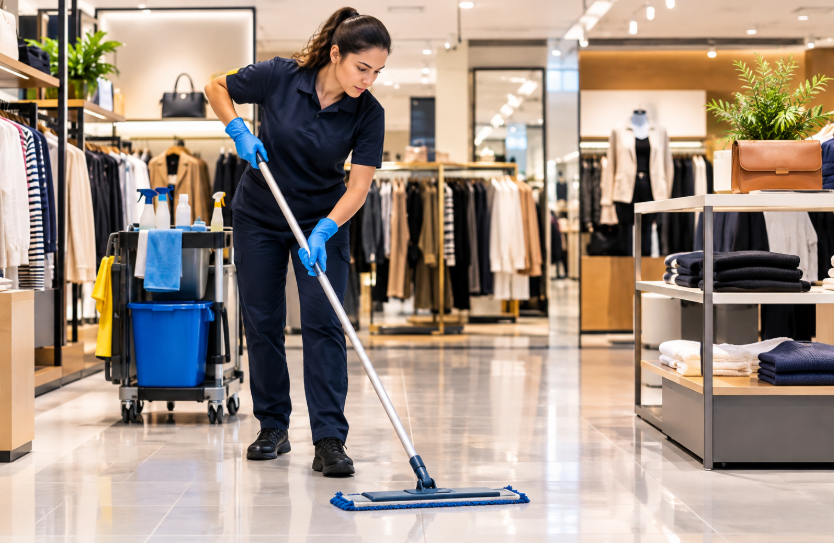
Retail spaces get judged the moment a customer walks through the door, in a way that few other commercial environments experience quite so directly. An office visitor might overlook a slightly dusty shelf in a back corridor. A shopper won’t overlook a sticky floor, a grubby changing room, or a display covered in fingerprints — and in a competitive high street or shopping centre, that first impression often decides whether they stay to browse or walk straight back out.
Retail cleaning gets treated too often as a smaller version of office cleaning — same checklist, same schedule, just applied to a different type of space. In reality, shops face a different set of pressures entirely: constant footfall, customers touching merchandise all day, changing rooms that see dozens of uses between cleans, and opening hours that leave a genuinely narrow window for proper cleaning without disrupting trade. Getting this wrong doesn’t just look untidy — it affects sales, brand perception, and how long customers are willing to stay in-store.
This guide looks at what makes retail cleaning genuinely different from general office cleaning, which areas of a shop carry the highest risk of being overlooked, and what to expect from a properly structured commercial cleaning Liverpool contract built around a retail environment rather than adapted from one designed for offices.
Why Retail Footfall Changes the Cleaning Equation
The single biggest difference between a shop and an office is the sheer volume and pace of foot traffic. An office might see the same twenty or thirty people pass through a space across a working day. A busy Liverpool retail unit can see hundreds of different customers in the same period, each one touching merchandise, door handles, fitting room curtains, and payment counters.
This constant churn means grime, marks, and mess accumulate at a pace that a once-daily clean simply can’t keep up with. Floors pick up dirt and moisture from outdoor footwear throughout the day, glass and mirrors collect fingerprints within hours of being cleaned, and merchandise displays need regular attention just to stay presentable, let alone spotless.
The Brand Perception Cost of Getting This Wrong
Retail cleaning isn’t purely functional — it’s part of how a brand presents itself. A shop with a sticky floor or a dusty display sends a message about overall standards, whether or not that message is fair. Customers rarely separate “the cleaning wasn’t great today” from “this store isn’t well run,” and that perception shapes purchasing decisions more than most retailers realise.
The Areas of a Shop Most Likely to Be Overlooked
Some parts of a retail space get attention automatically because they’re highly visible. Others slip through the cracks precisely because staff are focused elsewhere — usually on customers, sales, and stock.
Changing Rooms
Changing rooms see repeated use throughout the day, often with minimal time between customers to reset them properly. Mirrors, hooks, seating, and flooring all need regular attention, and a neglected changing room is one of the fastest ways to undermine an otherwise well-presented shop floor.
Till Points and Payment Areas
Counters, card machines, and till surfaces are touched constantly by both staff and customers throughout the day, making them high-contact areas that benefit from more frequent cleaning than a once-a-day pass typically provides.
Entrance Mats and Flooring Near Doors
The area immediately inside a shop entrance takes the heaviest punishment, particularly in wet weather, and is also the first thing a customer sees and feels underfoot. Neglecting this zone undermines the effort put into the rest of the store.
See Also: Follistatin 344: A Careful Look at What the Evidence Actually Supports
Display Units and Merchandise
Shelving, rails, and display units accumulate dust and fingerprints from constant handling, and because staff are usually focused on stock levels and presentation rather than cleanliness specifically, this area is easy to overlook until it’s visibly grubby.
Glass, Windows, and Mirrors
Fingerprints and smudges on glass are immediately noticeable to customers, even if they’re barely conscious of registering it. Clean glass genuinely affects how bright and well-presented a store feels, particularly for window displays designed to draw people in from outside.
What a Properly Structured Retail Cleaning Contract Should Include
Given the pace and visibility of retail spaces, a cleaning plan needs to reflect how the store actually operates, not a generic template borrowed from office cleaning.
Cleaning Scheduled Around Trading Hours
Unlike offices, which are often empty outside a fixed window, retail cleaning frequently needs to happen before opening, briefly during quieter trading periods, and after closing, without disrupting customers or stock replenishment.
Higher Frequency on High-Touch, High-Visibility Areas
Till points, door handles, and changing rooms benefit from multiple touch-points throughout the day rather than a single end-of-day clean, particularly for busier stores or those in high-footfall locations.
Floor Care Suited to the Specific Surface
Retail flooring varies significantly — hard flooring, carpet tiles, or a mix across different zones — and each needs an appropriate cleaning method rather than one generic approach applied uniformly across the whole store.
Seasonal Flexibility for Weather and Footfall Spikes
Wet weather brings in significantly more dirt and moisture, and busier trading periods (weekends, sales events, the run-up to Christmas) increase footfall dramatically. A good retail cleaning contract flexes around this rather than applying the same fixed schedule year-round.
Choosing Cleaning Agencies With Genuine Retail Experience
Not every provider that handles office cleaning is equally equipped for the pace and visibility demands of a retail environment, and it’s worth being specific when evaluating options.
Ask About Experience With Similar Retail Formats
A provider experienced with small boutique units may approach things differently to one used to larger department-style stores. Ask about direct experience with retail spaces of comparable size and footfall to yours.
Confirm They Can Work Around Trading Hours
Retail cleaning often needs early morning, brief in-hours, or after-closing visits, sometimes all three. Confirm a provider’s flexibility and reliability around these windows before committing.
Ask How They Handle Customer-Facing Areas Specifically
Changing rooms, till points, and entrance areas deserve specific attention in any proposal a provider puts forward, rather than being folded generically into a broader “general cleaning” line item.
Local Knowledge of Liverpool’s Retail Environment
A provider with direct experience across Liverpool’s retail locations — from city centre units to out-of-town retail parks — understands the practical realities of footfall patterns, seasonal trading spikes, and building-specific challenges better than a generic national chain. Maid Right Cleaning Ltd, for instance, brings that local familiarity alongside broader commercial cleaning Liverpool experience across offices and other business types, which helps when a retail business also has stockrooms, staff areas, or admin offices needing the same standard of care.
Simple Habits Retail Staff Can Maintain Between Professional Visits
Professional cleaning covers the bulk of the work, but a few consistent habits from shop floor staff help maintain standards between scheduled visits:
- Spot-check changing rooms between customers where staffing allows, tidying and resetting rather than waiting for the next full clean.
- Wipe down till points periodically during quieter moments throughout the day.
- Address spills immediately, particularly on hard flooring near entrances where slip risk is highest.
- Flag recurring problem areas to your cleaning provider, so the schedule can be adjusted to reflect where attention is genuinely needed most.
Frequently Asked Questions
How often should a retail store be professionally cleaned? Most retail stores benefit from daily cleaning at minimum, with higher-footfall stores or those in busy locations often requiring cleaning both before opening and periodically during trading hours to maintain standards throughout the day.
Why does retail cleaning cost more than a similarly sized office clean? Retail spaces typically need higher-frequency attention to high-touch, customer-facing areas, plus flexible scheduling around trading hours rather than a single fixed daily window, which generally increases the scope and cost compared to standard office cleaning.
What’s the most commonly overlooked area in retail cleaning? Changing rooms and entrance flooring are among the most frequently overlooked areas, largely because staff attention is focused on customers and sales rather than cleaning specifically, allowing grime to build up unnoticed between scheduled cleans.
Can one cleaning agencies provider handle both our shop floor and back-office areas? Yes, most established commercial cleaning providers cover both customer-facing retail areas and staff or admin spaces under a single contract, which is generally more efficient than managing separate providers for each.
Does retail cleaning need to happen outside trading hours? Not always, but it typically requires more flexibility than office cleaning. A combination of before-opening, brief in-hours attention to high-touch areas, and after-closing cleaning is common for busier stores.
Final Thoughts and Next Steps
Retail cleaning carries a different kind of pressure to general office cleaning, simply because of how directly it affects customer experience and brand perception in real time. A cleaning plan built specifically around footfall patterns, high-touch customer areas, and trading hours makes a genuine difference to how a store feels to shop in, and ultimately to how long customers choose to stay.
If your current cleaning arrangement feels more like a generic office package applied to a retail space, it’s worth reassessing whether it’s genuinely built for your store’s pace and visibility demands. Get in touch with Maid Right Cleaning Ltd to discuss a retail-specific cleaning plan for your Liverpool store, and find out what a properly structured approach could mean for how customers experience your space.